

Most marketing teams assume automation is fundamentally about doing more with less effort. Send more emails. Trigger more follow-ups. Reach more contacts in less time. That framing is understandable, but it misses the real opportunity. The teams seeing the biggest results from enterprise outreach aren't just automating volume. They're building intelligent systems that coordinate timing, channels, and messaging in response to real behavior. This article breaks down how that shift happens, what the data actually says about AI-driven outreach, and how to design campaigns that scale without losing the human credibility that drives replies.
Table of Contents
- Redefining automation: Orchestration over simple scale
- Where automation wins and where it falls short
- Designing effective automated multi-channel campaigns
- Key considerations and common mistakes in automation
- Automation in outreach: What actually works versus what's just hype
- Take the next step with smarter outreach automation
- Frequently asked questions
Key Takeaways
| Point | Details |
|---|---|
| Orchestration matters | True value comes from orchestrating multi-channel outreach, not just automating tasks. |
| Hybrid approach wins | Combine automation for scale with human expertise for high-value engagement. |
| Watch deliverability | AI increases volume but can trigger more spam flags and lower engagement without careful oversight. |
| Personalization is key | Dynamic, behavior-driven messages outperform generic and rigid sequences. |
Redefining automation: Orchestration over simple scale
To understand why not all automation is created equal, let's clarify the leap from simple tools to orchestrated solutions.
Most early automation tools operated in silos. Your email sequence ran on its own schedule. Your LinkedIn outreach ran separately. Your SMS follow-ups had no awareness of what happened in the other channels. The result was predictable: contacts received overlapping messages, reps had no unified view of engagement, and the "automated" experience felt mechanical and disconnected.
True orchestration is a different model entirely. For enterprise-scale multi-channel outreach, automation functions as a single intelligence layer that coordinates channel timing and next-best-action logic rather than running separate tools in parallel. That means one system decides: if a contact opened the email but didn't click, wait 48 hours and send a LinkedIn message. If they clicked but didn't reply, escalate to a phone call. If they replied with a question, pause all automation and route to a human rep immediately.
This kind of logic prevents channel collision, which is one of the most damaging problems in enterprise outreach. Channel collision happens when a contact gets an email, a LinkedIn connection request, and a cold call within the same 24-hour window from the same company. It signals disorganization and burns trust fast.
"Orchestration isn't about doing everything at once. It's about doing the right thing at the right moment, based on what the recipient actually did."
Here's a quick comparison of how simple automation stacks up against orchestrated outreach:
| Feature | Simple automation | Orchestrated outreach |
|---|---|---|
| Channel awareness | Single channel | Cross-channel coordination |
| Decision logic | Time-based triggers | Behavior-based triggers |
| Personalization | Template-level | Dynamic, context-aware |
| Collision prevention | None | Built-in suppression logic |
| Human handoff | Manual | Automatic escalation |
| Reporting | Per-channel | Unified engagement view |
The benefits of orchestration extend well beyond avoiding embarrassing overlaps. When your outreach automation platforms can adapt in real time based on how a contact engages, you stop wasting budget on contacts who already converted or disengaged. You concentrate effort where the signal is strongest.
Key advantages of orchestrated outreach include:
- Adaptability: Campaigns adjust based on live engagement signals rather than a fixed calendar
- Personalization at scale: Messaging reflects the contact's actual behavior, not just their industry segment
- Efficiency: Reps spend time on warm conversations, not cold follow-up sequences
- Consistency: Every contact gets a coherent experience regardless of which channel they engage on first
Where automation wins and where it falls short
Now that we see how orchestration elevates outreach, it's equally important to understand the limitations and strengths of automation in practice.
Automation genuinely excels at a specific set of tasks. Consistent follow-up sequencing. Removing manual data entry from reps' plates. Triggering the right message at the right stage of a pipeline. Routing inbound replies to the correct team member. These are high-volume, rule-based tasks where automation is simply faster and more reliable than any human.

But the data tells a more nuanced story when it comes to AI-generated content. A large paired dataset analysis of over 100,000 emails found that AI-written cold emails can lag behind human-written emails on reply rates and meeting booking rates, with a measurable deliverability penalty from higher spam-flag rates. This doesn't mean AI-written outreach is ineffective. It means the gap is real and needs to be managed.
Here's how the performance metrics compare across key indicators:
| Metric | AI-written outreach | Human-written outreach |
|---|---|---|
| Average reply rate | Lower in most datasets | Higher, especially for cold outreach |
| Meeting booking rate | Moderate | Higher for personalized messages |
| Spam flag rate | Elevated in some analyses | Lower with authentic copy |
| Throughput volume | Very high | Limited by rep capacity |
| Consistency | Extremely high | Variable by rep skill |
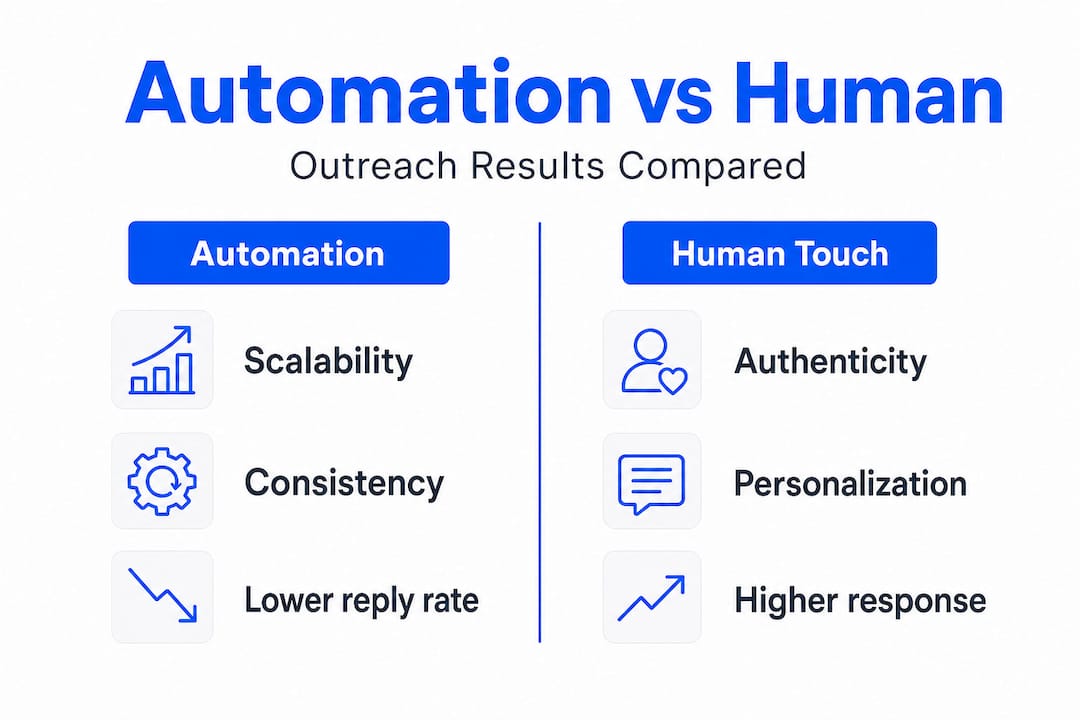
The pattern is clear. AI-powered outreach wins on scale and consistency. Human outreach wins on authenticity and conversion quality. The smart play isn't to choose one. It's to use each where it performs best.
Pro Tip: Use automation to handle the first two to three touchpoints in a sequence, then have a real person step in for the fourth contact, especially if the prospect has shown any engagement signal. This blend dramatically improves meeting rates without sacrificing scale.
Where automation falls short most visibly is in relationship-heavy contexts. Enterprise deals with long sales cycles, multiple stakeholders, and high contract values need human judgment at key moments. A bot can't read the subtext of a reply that says "interesting, but our budget cycle doesn't start until Q3." A skilled rep can.
The other area where automation struggles is authenticity. Buyers have become remarkably good at detecting templated outreach. Phrases like "I came across your profile and was impressed" or "I wanted to reach out because I noticed..." have been so overused that they now trigger skepticism rather than curiosity. Automation that generates these patterns at scale accelerates the damage.
Designing effective automated multi-channel campaigns
With both the strategic framework and limitations clear, let's look at how to actually build winning automated campaigns.
The most effective enterprise outreach campaigns share a common architecture. They start with a clear understanding of who they're reaching, map out the ideal journey for that persona, and then build logic that responds to real behavior rather than assumed timelines.
Here's a practical framework for building campaigns that actually convert:
-
Define your personas with precision. Go beyond job title and industry. What problems are they actively trying to solve? What channels do they actually use? What does a good day look like for them? The more specific your persona definition, the more relevant your messaging will be at every touchpoint.
-
Map the ideal engagement journey. For each persona, sketch out the sequence of touchpoints that would feel natural and helpful rather than intrusive. This usually means starting with lower-commitment channels like email or LinkedIn, then escalating to phone or SMS only after some engagement signal has been detected.
-
Design behavior-based logic triggers. This is where orchestration happens. Define rules like: if email opened but not clicked after 72 hours, send LinkedIn message with a different value angle. If LinkedIn connection accepted, wait 48 hours then send a personalized note. If no response after five touchpoints, move to a low-frequency nurture sequence rather than continuing aggressive outreach.
-
Test and iterate continuously. Run A/B tests on subject lines, message copy, send times, and channel sequences. Analyze not just open rates but downstream metrics like meetings booked and pipeline created. Most teams iterate too infrequently because campaign setup feels expensive. With modern tools, iteration should be fast and cheap.
A hybrid approach to automation that blends structured automation with human judgment is consistently recommended as the most effective model for enterprise campaigns. Automate where structure and scale matter, but keep human effort where context and relationship trust dominate.
The most common mistakes teams make when building automated campaigns include:
- Over-automation: Automating every single touchpoint removes the human moments that build trust
- Channel collision: Sending across multiple channels simultaneously without coordination creates a chaotic experience
- Generic messaging: Using the same template for every contact in a segment ignores the behavioral and contextual signals you've collected
- Ignoring suppression logic: Failing to remove contacts who have already replied, converted, or opted out creates negative experiences at scale
Pro Tip: Reserve your most personalized, human-crafted messages for contacts who have already shown a strong engagement signal. Spending that effort on cold, unresponsive contacts is inefficient. Let automation handle the cold end of the funnel and save human creativity for warm conversations.
Key considerations and common mistakes in automation
Even well-designed campaigns can run into common challenges. Here's what marketing leaders should prioritize and avoid.
Deliverability is the silent campaign killer. Your outreach can be perfectly designed, sequenced, and personalized, but if it lands in spam, none of that matters. AI-generated copy can trigger higher spam-flag rates compared to human-written messages in some datasets, which means teams relying heavily on AI content generation need to invest in deliverability monitoring as a core part of their stack.
The key considerations every enterprise outreach team should address:
- Authenticate your sending domains. SPF, DKIM, and DMARC records are non-negotiable for improving deliverability at scale. Without them, even great copy will get filtered.
- Warm up new sending infrastructure gradually. Jumping from zero to high-volume sending on a new domain or IP is a fast path to blacklisting.
- Monitor reply sentiment, not just reply rate. A high reply rate that includes mostly "unsubscribe" or "stop emailing me" responses is a signal that your targeting or messaging is off.
- Audit your templates for authenticity. If a message sounds like it could have been written by anyone for anyone, it probably won't convert. Specificity is the antidote to the robotic feel that kills automated outreach.
- Build in regular human review cycles. Automation should run on rails, but a human should review campaign performance weekly and spot-check message quality regularly.
"The biggest risk in enterprise outreach automation isn't that it won't scale. It's that it will scale the wrong thing. A flawed message sent to 10,000 contacts does 10,000 times the damage."
Timing coordination across channels deserves special attention. When a contact receives a LinkedIn message, an email, and a phone call within the same morning, the experience feels like pressure rather than value. Orchestration logic should enforce minimum time gaps between touchpoints on different channels, and should suppress outreach entirely once a contact has engaged meaningfully.
Automation in outreach: What actually works versus what's just hype
With the core strategies and watchouts covered, it's time to step back and look at what really moves the needle in enterprise outreach.
There's a tempting narrative in the market right now: just automate everything, let AI write your copy, and watch pipeline grow. The appeal is obvious. It sounds like leverage. But in practice, teams that go all-in on full automation often see initial volume gains followed by a plateau, or worse, a deliverability collapse that takes months to recover from.
The uncomfortable truth is that automation is a force multiplier. It multiplies whatever you put into it. If your messaging strategy is strong, your personas are well-defined, and your channel logic is intelligent, automation will scale those strengths dramatically. If your strategy is weak, automation will scale the weakness just as efficiently.
What we've seen work consistently in enterprise outreach is a model where real-world orchestration tools handle the infrastructure layer while skilled humans own the strategy and relationship layers. Automation decides when to send, which channel to use, and when to escalate. Humans decide what to say, how to position value, and when to walk away from a deal that isn't moving.
This isn't a compromise position. It's actually the highest-performance model available. Skilled outreach professionals who are freed from manual follow-up sequences have more time for the conversations that actually close deals. Automation doesn't replace them. It removes the work that was never a good use of their skills in the first place.
The hype around full AI automation often obscures a simpler reality: the teams winning at enterprise outreach are the ones who are most thoughtful about where human judgment adds irreplaceable value and where automation creates genuine efficiency. Volume is easy to generate. Trust is not.
Take the next step with smarter outreach automation
If you're ready to transform your campaigns with the principles above, here's where to start.
Orchestrated, intelligent automation isn't just a competitive advantage anymore. For enterprises managing complex, multi-channel outreach at scale, it's becoming the baseline expectation. Piecemeal tools that don't talk to each other create the exact channel collision and deliverability problems that erode campaign performance over time.
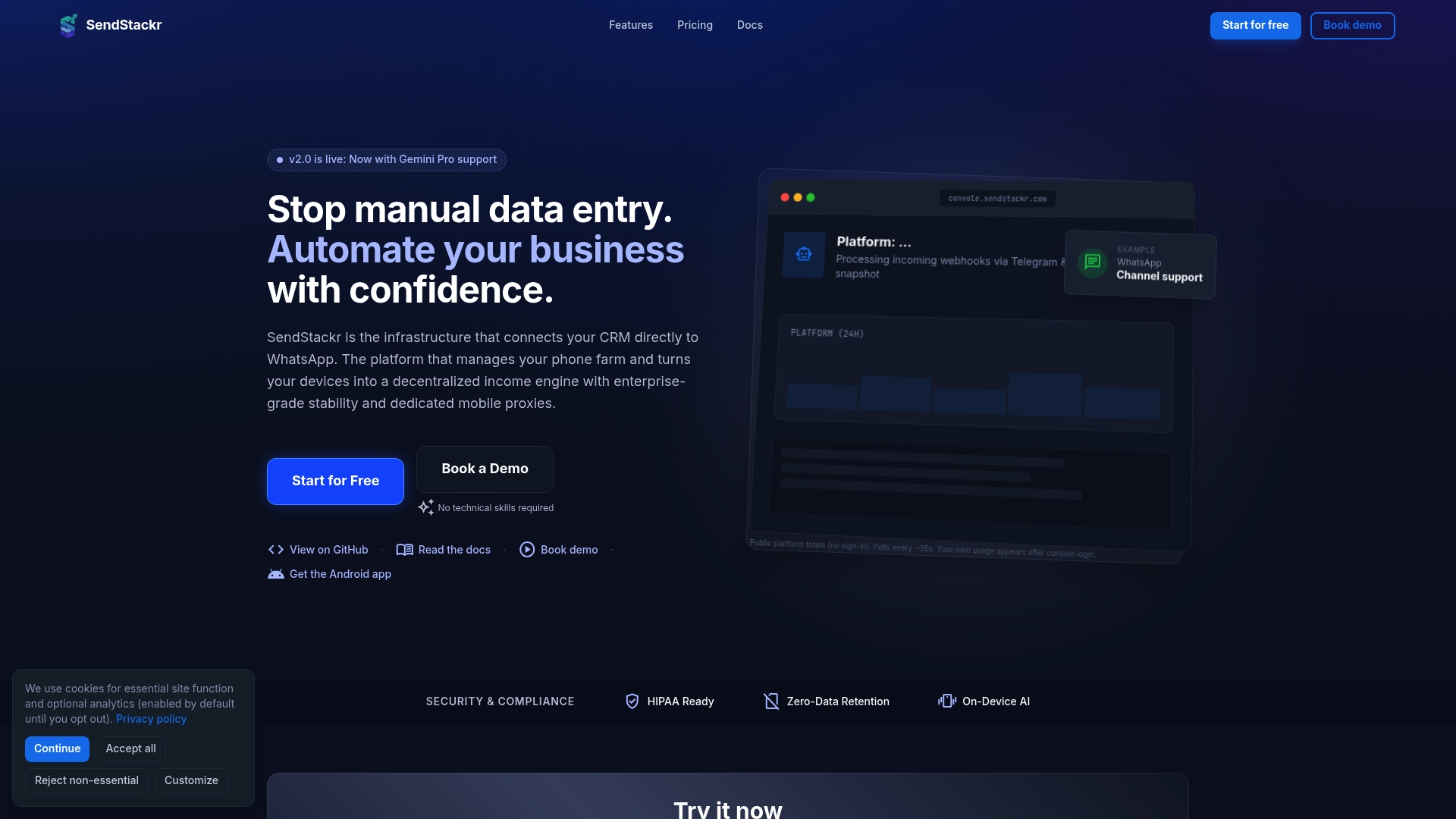
The SendStackr platform is built specifically for the kind of multi-channel orchestration this article describes. From AI-driven message processing and real-time SMS forwarding to WhatsApp integration and drag-and-drop workflow building, SendStackr gives enterprise teams the infrastructure to run coordinated, behavior-responsive outreach without requiring engineering resources. If your current stack is creating friction instead of flow, it's worth exploring what a purpose-built orchestration platform can do for your campaigns.
Frequently asked questions
What's the difference between simple automation and orchestration in outreach?
Orchestration coordinates timing, messaging, and actions across channels in real time, while simple automation just sends pre-set sequences without awareness of cross-channel behavior or engagement signals.
Does AI-written outreach perform as well as human-written outreach?
AI-written cold emails can lag behind human-written messages on reply rates and meeting bookings, and may face a higher spam-flag rate, though they offer significant advantages in throughput and consistency.
What tasks should be automated versus handled manually in outreach?
Automation works best for repetitive workflows, follow-up sequences, and data-driven routing; human judgment should remain in control for complex relationship moments, high-value negotiations, and context-sensitive responses.
How can I avoid my automated outreach being marked as spam?
Authenticate your sending domains, avoid overused templates, and monitor deliverability metrics closely. AI-generated content can carry a higher spam-flag risk, so blending automation with human review of copy quality is a practical safeguard.